If your boiler is misbehaving, it can be difficult to decide whether a simple repair will fix the issue or if replacing the entire system is the safer and smarter choice. Considering factors like safety risks, ongoing reliability, and overall performance will help you make a clear, confident decision that protects your home and keeps your heating running smoothly.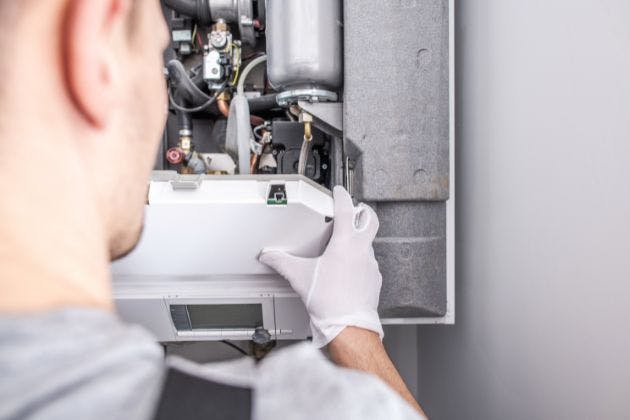
Warning signs that boiler replacement may be safer
Some boiler problems are simply inconvenient, while others point to deeper safety or reliability issues. If you spot several of the signs below, it is sensible to talk to an engineer about whether replacement is the safer long-term choice.
Frequent breakdowns: Call-outs every few months, often for different faults
Pressure problems: Boiler pressure keeps dropping or rising despite topping up
Leaks or corrosion: Rust, staining or water around the boiler or pipework
Flame or pilot issues: Yellow or unstable flame, pilot light keeps going out
Carbon monoxide concerns: CO alarm activating, sooting or scorch marks
Repeated lockouts: Boiler regularly shuts itself down and needs resets
Obsolete parts: Engineer struggling to source safe, manufacturer-approved parts
Repeated faults can suggest wear throughout the appliance, not just one faulty part. Corrosion on the case, flue or internal components also raises concerns about structural integrity and safe combustion.
Anything that hints at poor combustion, such as yellow flames, soot, or a carbon monoxide alarm going off, must be treated as urgent. In that situation, turn the appliance off, ventilate the area and contact a Gas Safe registered engineer immediately.
When a boiler repair is a reasonable option
Not every fault means you need a new boiler. In many cases, a safe repair from a competent engineer is a perfectly sensible choice, especially if the boiler is relatively modern and has been well maintained.
Repair is often a good route when there is a clear, isolated component failure such as a faulty fan, pump, sensor or diverter valve. If the rest of the boiler is in good condition, replacing that part can restore reliable performance.
The overall age and service history of your boiler also matter. A boiler that is under 10 years old, has been serviced annually and has no signs of significant corrosion is more likely to benefit from repair. Engineers will also consider whether high quality, original parts are still readily available.
After a successful repair, your engineer should test the boiler thoroughly, checking combustion, controls and safety devices to make sure it is operating safely and efficiently before they leave.
How an engineer assesses your boiler and heating system
Deciding between repair and replacement should never be guesswork. A proper assessment from a Gas Safe registered engineer looks at the boiler, flue and wider heating system to build a full picture of safety and performance.
Visual checks and safety devices
The engineer will start with a visual inspection. They will look for signs of leaks, corrosion, scorching or damaged insulation, as well as checking ventilation and that the flue is correctly fitted and supported.
They will test key safety devices such as pressure relief valves, thermostats and flame detection. If safety devices are missing, bypassed or repeatedly operating, this will heavily influence any recommendation.
Flue and combustion analysis
On modern boilers, a flue gas analyser is used to measure combustion. The readings show whether the boiler is burning gas cleanly and within the manufacturer limits, which is essential for both safety and efficiency.
The engineer will inspect the flue route, terminal position and joints to make sure there are no signs of damage or leakage. Poor flue condition or non-compliant flue routes can be a strong argument for replacement, particularly on older properties.
System pressure, condensate and radiator performance
As part of the assessment, the engineer will check system pressure over time, not just in the moment. Constant pressure loss may point to hidden leaks or expansion vessel problems that need to be resolved.
On condensing boilers, the condensate trap and pipework are checked for blockages, freezing risks and correct routing to prevent leaks or nuisance shutdowns. The engineer should also feel or measure radiator temperatures to see whether heat is being distributed evenly.
Sludge, cold spots and noisy pipework may not always mean the boiler must go, but they do indicate that the system needs cleaning or balancing, which can be part of a repair plan or factored into a replacement.
What changes when you replace your boiler
If replacement is recommended, it is not just a like-for-like swap. A good installation will consider boiler type, controls, system protection and compliance paperwork so your heating is safer and easier to live with.
Choosing the right boiler type
Your engineer should look at how you use hot water and heating, the size of your property and any future plans such as extensions. From there, they can advise whether a combi, system or heat only boiler is the most suitable option.
Correct boiler sizing is crucial. An oversized boiler can short cycle and wear out components, while an undersized one may struggle in cold weather. This is why a proper survey is important before you commit.
Controls and efficiency upgrades
Modern boilers work best with modern controls. As part of a replacement, you can often upgrade to programmable thermostats, smart controls or weather compensation to give better comfort and more stable operation.
Good controls also reduce strain on the boiler by avoiding constant on-off operation. Simple improvements such as thermostatic radiator valves and proper zoning can make your system more responsive and consistent.
System protection and required paperwork
New boilers should be protected with correct filtration, such as a magnetic filter, and treated system water. In some cases, system flushing or cleaning will be recommended to remove sludge that could damage a new appliance.
After installation, you should receive benchmark commissioning paperwork, user instructions and confirmation that the boiler has been notified to the relevant bodies. This paperwork supports your warranty and shows the work has been carried out to the correct standard.
What to do next if you are unsure
If you are weighing up boiler repair vs replacement, the safest route is to arrange a survey with a Gas Safe registered engineer who can assess your specific setup. Take note of any recent issues so you can explain the history clearly.
During the visit, ask about boiler sizing, suitable boiler types for your home and what controls upgrades would make your system more reliable. Make sure you see proof of Gas Safe registration and feel comfortable asking questions about safety checks and testing.
Quick answers to common boiler questions
How long do boilers last?
Most modern gas boilers typically last around 10 to 15 years when serviced regularly, although some can run longer if they are well maintained and correctly installed. After this point, reliability and efficiency often begin to drop, and safety standards on older models may not match current requirements.
Is a noisy boiler dangerous?
Not all noise is dangerous, but any new or worsening sound deserves attention. Kettling, banging or loud whistling can indicate limescale, sludge or circulation issues that, if ignored, may lead to overheating or component failure.
If your boiler becomes suddenly noisy or you notice smells, scorching or signs of overheating alongside the noise, switch it off and contact a Gas Safe registered engineer promptly.
Do I need a power flush?
You may not always need a full power flush. In some cases, targeted cleaning, chemical flushes or filter installation are enough. Signs that some form of cleaning may help include cold spots on radiators, slow heat up times and dirty system water.
Your engineer should test and inspect the system water to advise on the right level of cleaning. Over-flushing a delicate older system can cause its own problems, so the approach should always be tailored to your pipework and radiators.
Need expert help with boiler decisions in Sheffield, Rotherham, and Barnsley?
If you are unsure whether your boiler is safe to repair or it is time for a replacement, a professional assessment will give you clear, practical options. For advice on new boilers, visit the Boiler Installation service page from D.E.S. Gas Safe Solutions, and for checks, servicing, and fault-finding, see their Domestic Gas Services page.
To arrange a survey or speak to a Gas Safe registered engineer about your boiler, contact D.E.S. Gas Safe Solutions on 01143211817.